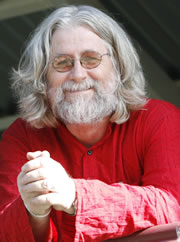
"I like to think of Dave
Andrews as a... weirdy, beardy, proverbially wise-old,
kind-old, be-slippered, fire-sided, snoozy, fearless,
story-telling, grand-fatherly, rugged, tribal-leader.'
Martin
Wroe - Greenbelt
More Information:
|
|
·
wecan.be
·
Waiters Union
· Waiters
Union Training Options ·
Compassionate
Community Work Course |
|
Living Community...
Reviews
Foreword
Introduction
Reading List for Living Community
Reviews
‘I have known
Dave Andrews for a long time. I read his first book, Can
You Hear The Heartbeat? in the early 90s and was
inspired by its vision to spend time with the Waiters
Union in Brisbane’s West End to experience the kind of
transforming community relationships described by Dave
for myself. It was an exhilarating and challenging
experience and has continued to shape who I am and my
relationship with my own neighbourhood wherever I have
lived since.
‘Dave (who
will hate me for writing this) is a bit of a poster boy
for all of us who long to work …in our communities but
don’t really know how to start. He, Ange, and the rest
of the Waiters Union have struggled over the years to
live out their faith in solidarity with those who are
vulnerable or disadvantaged in their local area. Over
time, Dave has learnt a thing or two about taking risks,
acting with integrity, persistence, courage, respect and
hope, and shares this hard won wisdom in Living
Community.
‘If you’ve
ever wondered about just exactly how to stand in
solidarity with those who are vulnerable or
disadvantaged in your community, but are not sure what
that means, or how to get there, then Living Community
is the book for you.
‘It’s an
intensely practical workbook that can be studied
formally as a subject in an educational institution or
(hooray) at home in your own community. This is a book
worth reading with a fluro pen in hand. Get up, go out
and grab a copy now.
‘But wait,
there’s more. Dave is available to run workshops,
seminars and residential intensives (contact details in
book), which means that you can organize a group or
groups in your church or community to work through the
sessions and have Dave around as an inspiration/guide.
‘People who
live the talk like Dave can be a bit like national parks
– although we probably will never go there, we feel good
knowing that they exist. Living Community provides a
map, with clear and empowering directions, to help us
move from a warm glow of appreciation to a place where
we too are resourced to have a go, to take a risk and to
work, dance, laugh and cry with our sisters and brothers
who are living on the edge.’
Lin Hatfield
Dodds National Director of UnitingCare, President of the
Australian Council of Social Service, and Chair of the
ACT Community Inclusion Board.
‘Living
Community is an important resource for today’s community
workers. Important, because these are challenging times
in which we live and work. A time when our political
and business leaders promote personal and national
notions of competition, rights, self-protection,
economic acquisition and consumerism. Perhaps not
necessarily negative concepts in themselves, but
problematic when working with communities considered
disadvantaged or marginalized. When self-interests
prevail and when the playing field is uneven, the
challenges to respond ethically and strategically are
great. Community workers, often driven by a desire to
build a better world for all its citizens, can find the
environments in which they work overwhelmingly
difficult. This work begins at a personal level and
takes us into public realms, where the territory can be
demanding, but also enormously rewarding. Living
Community is a tool which provides an important space
for reflection and learning - a space in which
individuals and learning groups can reflect on the
myriad of approaches to building and sustaining
community
‘Towards the
end of 2005 in Queensland, a conference took place where
over 220 community workers gathered to explore the
notion of community building and spirituality. The
presentations and workshops explored various aspects of
what drives and sustains our work in the world.
Remarkably, a conference like this had not been held in
Queensland before. Spirituality, one might say, is a
private matter, not necessarily something connected to
our work in the public sphere. However, feedback from
many conference participants indicated that spirituality
was not peripheral to their practice, but indeed,
central to it. One-off conferences are helpful for those
who were there, but Living Community is a text and tool
by which we can all benefit. Frameworks to help us
understand the complexity of the work; methods which
bring people together and create a shared analysis and
commitment to action; and processes which sustain us,
are important actions for community workers to
undertake. Some may call this a practice of
spirituality; others ethical practice. Whatever it is,
it is Living Community.’
Tina
Lathouras, Co-ordinator, Nambour Community Centre
‘At last a
community development ‘'bible'’ … With Living Community,
Dave makes another valuable and versatile offering to
community development theory and practice. It
represents a comprehensive ‘'gathering up'’ of years of
practice wisdom forged in challenging contexts.
Although impressive in scope, the emphasis is more on
how we engage with integrity. The material comes alive
when you actually do it and reflect on it not just by
reading it. It encourages a step by step building of
understanding and commitment. It's a call to action
from one who has walked the path before with humility
and deep compassion.
Jeremy
Liyanage, Senior Policy Officer, Brisbane City Council
Living Community is an ideal textbook for school age and mature students who wish to examine their ethical responsibility to the world around them. It is a practical resource for social workers, community organisers, and human rights advocates, as well as offering the layperson no nonsense pragmatic options for how to become more involved in one’s community. The book draws from sociological and psychological theorists, studies, and statistics to ground the coursework in these current and reputable scientific approaches to the study of human behaviour.
Along with secular attitudes, the book also gives examples on moral social behaviour from a wide variety of religious texts. Using a method of Socratic questioning, Living Community concerns the reader with developing themselves as active, participating, and responsible members of the community. It encourages the reader to develop their own definitions and meanings regarding the complexity of the relationship between self and community, and thus echoes Plato’s Republic in many ways, as Living Community asks the question: “What is the ideal society and how do we make it so?”
Rather than make explicit an approach of collectivist anarchist self determination Dave Andrews bases chapters (or ‘lessons’) in contemporary examples and biographical stories, parables, studies of social development, articles on community attitudes, numerous statistical analysis, and a wide variety of psychological approaches such as determinism, behaviourism and cognitive therapy. What makes this book especially clever, (and incredibly marketable) is that it is, in form, and to some extent content, similar to the ever popular self-help book. However, Living Community is about living as a conscious member of a society, and also about empowering the entire community not just the self. Thus it differs integrally from the self-help book’s materialist approach of status-orientated personal empowerment that privileges feeling good over doing good. Instead, Living Community is about understanding the relationship between members of the community and how all our actions affect each other’s quality of life.
The selection of research grounds the idealistic focus of the text. While it consciously aims to allow the reader the freedom to choose for themselves their own subjective answers in regard to how to help others, it undeniably promotes altruism. Dave Andrews offers numerous examples of how selfishness and exploitation fracture and weaken communities, while fair dealing and communication ensure their smooth running. Thus although the author adapts an approach of sitting back and feeding the reader numerous examples and questions, the book is framed by a presumption that people will look out for their community if this means it will improve their own life. In the context of our current individualist society, the subtly of this approach is extremely effective as it establishes the reciprocal nature of community involvement, and suggests that innate goodness exists in all humans, because without it our society would not function at all.
This presumption of the innate good in all people works in this context as most people like to believe themselves to be good; thus the self-examination of the course work is less daunting. The questioning of the self in the main section of the book not only evokes Socratic method, but also sends the reader into the realm of psychoanalysis. Fundamental questions of identity, motivation, fears, and loss, are not easy to take at the best of times. However, since the aim of this book is more about how one can become better able to co-operate, assist and influence social harmony, these hard questions act as a form of initiation into ‘humanity’. The self is broken down into a component of humans acting as a group. This acts to remove the sense of powerlessness and isolation of the individual versus society. Instead of an ‘us and them’ strategy, the book promotes a perspective of seeing the world in terms of their only being an ‘us’ and we each have a responsibility to the whole. The use of current social statistics and studies means the book is able to stabilise its idealistic aims with the contemporary lived experiences of people. These references legitimise the book’s philosophy by demonstrating examples of altruism in action.
Living Community offers a style and language perfect for community workers to follow in dealing with funding and bodies of authority. It wonderfully places itself as a bridge between our ideals and ways in which we can practically achieving them. While utopian in theme, the book’s structural approach of questions, exercises, readings, and bullet point notes, means that it reflects modern bureaucratic styles as well as offering useful appendixes of grant resources and even the UN Declaration of Human Rights. This deeply practical book is an ideal reference for anyone who needs guidance, support, and funding, to be more effective, honest and ethical in their dealings with humanity. It essentially offers the choice of numerous established and possible avenues, steps, and opportunities, for exercising our rights to enjoy and contribute to the functioning and development of our social environment.
Living Community asks us to see the world as not outside or ‘around us’ but as a living and ever-changing connection between all humans, where the world, and all people, and everything, is one. This ‘we are all one machine’ approach dissolves the isolation of the self, and is the first step to seeing a world where all humans are the same. Once this idea of the self as a component in a greater whole is grasped, the next step Living Community takes is understanding that the only person we can change is ourself, but by doing so we inevitably change the world.
Evelyn Hartogh 15 October 2007
Foreword
This is
written as a text book, but unlike any text book I’ve
read. It doesn’t keep its subject matter at arm’s
length, writing about it as object, in the third person,
enabling the reader to stay safely external and
scrutinising.
In a strange
way the book reads me. It challenges me about
instrumental friendships—about making the focuses of my
life everywhere else other than the very place where I
live. It plunges me deeper into my own life and it calls
forth a response that means I may not be the same person
at the end of this book than when I started.
It is an easy
read, but not a comfortable one. It is very engaging and
absorbing, yet you constantly have to put it down
because you need time to assimilate and wrestle with the
ideas that clash with—or sometimes clarify—your own
preconceptions. It is gently affi rming yet demanding.
Optimistic, even idealistic, yet thoroughly realistic.
May I commend
this to you as a book that takes seriously what it is to
be truly human, from the pen of someone who tries harder
than most to live it. May it sow many seeds of hope in
the grounds of despair and indifference in our cities,
towns and neighbourhoods. God knows that we need it.
David Busch
Social
Commentator and National Broadcaster
Introduction
About the Course
Living
Community is an introductory course on practical
community work. It can be studied formally as a
subject at college, or informally in your own
community.
In his study
of community, David Clark says:
‘community
[is] essentially a sentiment which people have
about themselves in relation to themselves: a
sentiment expressed in action, but still
basically a feeling. People have many feelings,
but there are two essentials for the existence
of community: a sense of significance and sense
of solidarity. The strength of community within
any given group is determined by the degree to
which its members experience both a sense of
solidarity and a sense of significance within
it’.
According to
psychologist Scott Peck:
‘If we are
going to use the word meaningfully we must
restrict it to a group of individuals who have
learned to communicate honestly with each other,
whose relationships go deeper than their masks
of composure, and who have developed some
significant commitment to ‘rejoice together,
mourn together’, ‘delight in each other, make
others’ conditions our own’.
After
researching five different intentional
communities, sociologist Luther Smith wrote:
‘The primary
indicator of communal well-being is that members
feel their fellowship approximates the qualities
of a caring family. Hardship and failures will
be the occasion for creative solutions and
increased resolve. They do not break the spirit
of a community. But loss of mutual respect and
steadfast caring strikes a deathblow at the very
heart of a community’.
Thus it is
our hope that this training will provide you
with the opportunity to explore the sense of
signifi cance and solidarity, which is at the
heart of community. Hopefully through this
learning experience, you will develop a sense of
deep mutual respect with people around you, as
in a healthy extended family in which you will
be free to ‘rejoice together and mourn
together’.
The
two dimensions of the course
The Living
Community course has an inner dimension and an
outer dimension. The outer dimension, the ‘body’
of the course, is the Australian National
Training Authority’s body of community
development knowledge, skills, principles,
practices, and competencies. The inner
dimension, or ‘soul’, is our passion for
in-situ, spiritual, experiential, personal,
relational, ethical, action-reflection community
work education.
The
outer dimension: The body of the course
The content
of this course addresses two units of competency
from the Community Services Training Package
(CHC02) endorsed by the Australian National
Training Authority:
CHCCD1A, which focuses on
support for community participation.
CHCCD9A, which focuses on
support for community leadership.
Underpinning
knowledge of community work
The
underpinning knowledge presented includes:
-
health
promotion (as per the Ottawa Charter)
-
local, state
and federal strategies/legislation
-
the nature
and the structure of the community
-
significant
cultural awareness—practices and protocol
-
impact of
cultural attitudes on organisational
planning
-
community
development principles and practices
-
community
development strategies, tactics, and methods
-
strategies
for encouraging community input and
-
participation
-
organisational systems, guidelines and
practice
-
concepts of
effective community leadership
-
availability
of skills development training
-
support
mechanisms and structures in context
-
organisational budget and funding allocation
-
funding
sources and their policies
Underpinning skills of community work
The
underpinning skills presented include:
-
formal and
informal networking
-
liaising with
a range of people
-
researching
community issues
-
developing
community policies
-
facilitating
community meetings
-
negotiating
community agreements
-
preparing
community budgets
-
marketing
community activities
-
evaluating
community programs
-
writing
community reports
Practical
content and process
This course
will give you the opportunity to
-
Clarify your
understanding of a spiritual approach to
-
community
-
Consider general
theories in relation to your particular
-
community
-
Experiment with an
experiential approach to community
-
work
-
Discover a personal
and relational approach to community
-
work
-
Develop an ethical,
action-refl ection approach to
-
community work
-
Analyse the issues
involved in doing sensitive community
-
work
-
Appreciate sensitive
responses which enhance both dignity
-
and solidarity
-
Identify and develop
opportunities for community
-
leadership
-
Provide support for
leadership structures and processes in
-
the community
-
Provide support for
leadership training and learning in the
-
Community
-
Demonstrate your
capacity to undertake a range of activities
-
to ensure appropriate
participation in community activities
-
Undertake a range of
activities to ensure appropriate
-
participation by
groups and individuals in community
-
activities
-
Develop an appropriate
range of skills, such as
networking
liaising
negotiating
facilitating
researching
writing
evaluating
budgeting
promoting
persevering
The
inner dimension: The soul of the course
An in-situ
course
Formal
community work training is usually conducted in
a college, while non-formal community work
training is usually conducted in the context of
the community. This course seeks to provide
in-situ community work training that can be done
formally for credit or informally for interest,
in the context of the community.
A
spiritual course
This course
seeks to provide people with the opportunity to
explore a dynamic spirituality that is essential
for developing a healthy community. We believe
that the practice of a radical spirituality of
compassion, as advocated in all the major world
religions, is not merely our best hope for
developing a healthy community—it is our only
hope.
An
experiential course
This course
seeks to provide the opportunity for people to
experience the ‘sentiment’, the ‘sense of
signifi cance and solidarity’ at the heart of
community: an opportunity to experience the
training to develop ‘deep mutual respect’ for
one another, as in a ‘healthy extended family’.
A personal
course
Community
work is a personal issue - it begins with us!
Either we can complain about the way things are,
or we can change the way they are, starting with
ourselves. This course can give people that
start.
A
relational course
Community
work is both a personal and a relational issue.
Change may start with us, but if it stops with
us, it will stop altogether! This course can
help us to help one another make the needed
change together.
An ethical
course
Community
work is at heart an essentially ethical
activity. There are no short cuts. There are no
quick fixes. We cannot develop our community
unless we ‘do unto others as we would have them
do unto us’.
An
action-reflection course
This course
will encourage us to remember that anything
worth doing is worth doing badly to begin with;
but if we want to do good, we should try to do
it better than we did before. We all need to
develop the capacity to reflect critically on
our actions.
Content and Outcomes
The content
of Living Community is divided into 30 sessions.
Part I (Sessions 1 to 15) helps people
understand the foundation principles of
practical community work. Building on those
foundations, Part II (Sessions 16 to 30) then
sets out the practices of community work in such
a way as to enable people to use these skills in
their own particular contexts.
When you
complete Living Community, you will be able to:
-
demonstrate a
developed understanding of community and
-
of community
work
-
articulate a
broad understanding of general theories
related
-
to community
work
-
analyse with
insight the issues involved in doing
practical
-
community
work
-
identify and
develop opportunities for practical
community
-
leadership
-
appreciate
sensitive responses which enhance dignity
and
-
solidarity
-
practise a
co-operative approach to community work
Learning strategies and learning partners
Living
Community includes processes, exercises, a set
text, study notes, additional readings, and a
simple series of community tasks that you can
work through, step by step, in the context of
your own community. This course includes a set
of instructions to assist you in self-managed
study. However, no course on community work
could possibly be done in total isolation. So
you will need a learning partner for this
course. It doesn’t matter if it is a new
acquaintance or an old friend. What matters is
that it is someone you believe you can work
with, someone you feel comfortable with, you can
collaborate with, and be accountable to. A
learning partner does not need to be present
when you do most of the study sessions. But
there are some sessions where it is absolutely
essential that you have one or two learning
partners with you, in order to be able to
explore with integrity the subject you are
studying. The learning partners for these
sessions need not be learning partners you have
chosen for the whole course, but any helpful
people who might be available.
Learning responsibilities and resources
You alone are
responsible for your own learning. To get the
most out of your study of Living Community, you
need to follow the instructions in each session
on a weekly basis—including reading the
materials, talking things over with a learning
partner, answering the questions, completing the
set community tasks and writing up the working
notes.
To do all the
work the course entails, you need to set aside
at least 2½ hours for each session, and a
further 2½ hours for the tasks associated with
each session. It would take about 5 hours a
week.
At the end of
each session, we have set Community Tasks that
you are encouraged to do. These tasks provide
the simple activities that are the basis for the
action and reflection at the heart of the
course.
You are
encouraged to keep Working Notes made up of
informal personal reflections on specific
lessons you learn from this course through your
engagement with community development theory and
practice in your community. Working Notes are
not an objective reporting of events, per se,
but more subjective, personal reflections on
some of the thoughts, feelings and issues that
the course raises for you to consider.
While reading widely on
the topic of community development is strongly
encouraged, we have tried to provide enough
resources for you to read without having to
access a library. The Readings (listed in
Appendix B) have been provided at http://www.daveandrews.com.au
In addition
to Living Community, you will need additional
materials tocomplete the course. The articles,
stories and assignment guidelines are all
available on
http://www.daveandrews.com.au
Training Resources and Responsibilities
Your
responsibilities are
related to community and community work;
the
context of today’s world;
work;
solidarity in:
the
principles of practical community work
the practices
of practical community work
the
opportunities for community leadership
leadership
structures and processes in the community
leadership
training and learning in the community
a range of
activities to ensure participation in community
activities
You need to
encourage students to study Living Community,
following the instructions in the each session
(including reading the materials, talking things
over with a learning partner, answering the
questions, and writing up the Working Notes) on
a weekly basis where possible.
If students
are studying the course for accreditation, you
will also need to encourage them to
-
participate
in a Residential Intensive (if required)
-
complete the
weekly Community Tasks
-
complete the
weekly Working Notes
-
complete the
Essays and Reports
Students
should be encouraged to set aside at least 2½
hours for each session, 2½ hours for the tasks
associated with each session, 3 hours per week
for additional reading, and 2 hours for writing.
This means that students should aim to dedicate
at least 10 hours a week to this course.
The best way
of encouraging students is to meet with them at
least once a week every week for a couple of
hours. If that is not possible, you may want to
consider staying in touch with them by phone
and/or email, and organise a Residential
Intensive once or twice during the course.
The Community
Tasks that need to be completed are at the end
of each session. These tasks provide the simple
activities that are the basis for the action and
reflection at the heart of the course. The
Reports that students are expected to write are
based on the Working Notes they keep on these
Community Tasks.
The Working
Notes are to be made up of informal (but
legible) personal reflections on specific
lessons that students learn from this course,
through their engagement with community
development theory and practice in their
community. The Working Notes are not the Reports
but form the basis for the student’s Reports.
Working Notes are not an objective reporting of
events, per see, but more subjective, personal
reflections.
Note:
Working Notes should not be graded but
should be submitted as evidence of the student’s
personal learning progress.
Two formal
Reports are to be submitted, one for each half
of the course, framed around:
The Reports
should demonstrate the student’s theoretical and
practical understanding of community work within
the framework of the student’s personal world
view. Reports should be based on the weekly
Working Notes they keep on their Community
Tasks. Honesty, authenticity and creativity in
these presentations should be rewarded. But
students should be reminded that while they may
be personal and practical, these Reports are
assessable pieces of work. References and
research need to be adequately cited, and a
Bibliography appended.
Reports by
degree students should be 2,000 words, diploma
students should be 1,500 words and certificate
students should be 1,000 words.
Two Essays
are to be written, one for each half of the
course, each essay demonstrating an in-depth
understanding of one aspect of compassionate
community work. Students may either suggest a
topic for approval to the facilitator, or choose
one of the following suggested topics:
-
the
principles of practical community work
-
the practices
of practical community work
-
gender equity
and community work
-
indigenous
people and community work
-
migrants and
refugees and community work
-
disadvantaged
people and community work
-
community
work as a personal journey
-
community
work with local groups (clubs, churches etc
)
Essays by
degree students should be 3,000 words, by
diploma students should be 2,500 words and by
certificate students should be 2,000 words.
Facilitators
need to understand that not all students have
access to good libraries. While library research
is strongly encouraged where possible, we have
tried to provide the resources needed for
students to be able to complete essay writing
without accessing a library. Additional Articles
have been provided on the website:
http://www.daveandrews.com.au
|
|